Palmer Station Timeline
1975-85

Palmer Station in the 1976-77 summer (photo from Ed Born)
Summer 1975-76
Mary Alice McWhinnie works at Palmer Station for the first time.
Winter 1976
Manager: Larry Miyoda; population 6. (list and photos)
W/o Bill Fraser conducts major bird census.
Summer 1976-77
First desal units installed--peak production was 20 gallons per hour.

These were VERY small flash desalinization units of the same type in use at McMurdo, needed here particularly during the winter when the pond froze up. Initially they were located in the biolab as seen here (photos from Ed Schwalenberg). Here's a view from another angle.

Unused potable water tank cut up and removed from second floor of GWR above garage.

Another piece of the water system...here's what the seawater intake looked like in 1977 from shore (Gary Cullen) and from offshore (Ed Schwalenberg).

And from the other end of the station...

This summer 76-77 view from above the helo pad shows some of the, er. trash that has accumulated, waiting perhaps to be burned on a less windy day, or....?? (Ed Born)
Two prefab fiberglass "Heli-huts" (that would become the KARLs) shipped in for additional wet lab space
ATS-3 satellite used to set up direct VHF voice link to the US.
 The satellite had been launched in 1967 as a weather satellite, but after those instruments failed, its communications capabilities remained--it would allow a single telephone conversation as well as fax, so links were established at Palmer, originally to communicate with DRI as part of their X-band radar project which was studying air-sea weather interaction, to see if the patterns resembled weather over the Sierras. Links were also set up between Siple Station and Stanford for real-time communications about the VLF project (Pole would not get the ATS-3 phone link until 1984-85). Here's a view of the radome on the GWR roof; the small dish inside was originally designed to fit in the nose of an aircraft (photos from Ed Schwalenberg).

Hero runs aground near KGI and requires midseason repairs for bow damage; later in the summer she would be the second known US-flag ship to call at South Georgia in the past century.
Wayne Trivelpiece and D. Muller-Schwarze, then with SUNY Syracuse, venture to KGI in October to study penguins for the first time at Point Thomas (a few miles north of the future Copacabana site); their stay is cut short in December because of aforementioned damage to Hero
And shortly after they leave, the Poles arrive at Point Thomas and erect Arctowski Station (dedicated 26 February; the station fuel tanks now occupy Wayne's original tent site).
Winter 1977
Manager: Shane Williams; population 7 (list and photos)
Long-disused potable water tank in GWR (similar to the other steel tanks on station) cut up and removed, making more room for storage, and later the gym.
Summer 1977-78
LIDAR project set up using equipment used at Pole the previous 3 seasons (the DRI project would remain on station until at least 1980).
First permanent refuge hut constructed for penguin studies at Point Thomas near the new Arctowski Station in Admiralty Bay.
Two portable aquarium huts: KARLs (Krill Aquarium Research Laboratories) erected behind Biolab (site of present aquarium building).
Stanford VLF equipment installed?
Winter 1978
Manager: Pete Harding; population 9 (list and photo)
R/V Hero experiences record 9-day crossing from Palmer Station to Ushuaia (28 March-6 April) due to poor weather and mechanical issues--during an overhaul the previous year the turbocharger aftercooler cores had been replaced with fresh water cores...and both failed during the crossing.
Summer 1978-79
H&N takes over direct operation of Hero from subcontractor (12/1).
Station building exteriors painted.
KARL structures completed and dedicated.

The two prefabricated modules were located on the site of the present aquarium building. In this photo from 29 January they are nearly complete (and the Yelcho is in the harbor). The buildings were NOT named for 1990's PI David Karl, but rather by DA Stephen Brand, who was awarded 2 cases of beer by Buz Betzel as first prize in the naming. Here's another early winter photo showing the completed (and snow-covered) roofs. Photographer and 1979 w/o Allen Cull reported that the spot between the A-frame roofs was used for sunning on good days.

First precast planks installed to improve Zodiac boat ramp.
Desal units (installed in 1976-77) moved from the biolab to the power plant to utilize waste heat from the D-342 generators.
Winter 1979
Manager: John Konecki; population 10 (list and photo)
Summer 1979-80
Chilean submarine calls (8 December).
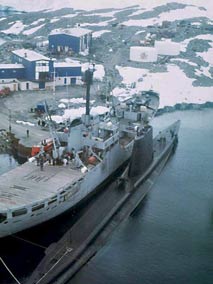
The sub was the Simpson (ex-USS Spot). It was accompanied by the Chilean Navy icebreaker Piloto Pardo and its two helicopters, which arrived at Palmer before the vessels. The helos carried several ship's officers and a cameraman from the Japanese film crew, which was working to produce the science fiction film Virus along with the chartered Lindblad Explorer.
While the U. S. Navy used a submarine, the USS Sennet, briefly and unsuccessfully in Operation Highjump in 1946-47, this may be the first and only visit of a military submarine to a post-IGY American Antarctic station...or ANY Antarctic station, for that matter.
The station crew invited all three ships to visit the station, although the Lindblad Explorer did not call. Here's the rest of this interesting story about the ships, the movie, and the aftermath of the Palmer visit.
Hero sent to Buenos Aires for emergency drydocking after a teredo infestation was discovered.
Cleanup activity--Yelcho hauls off 10 tons of scrap.
Winter 1980
Manager: Bryan Bertacchi; population 7 (list and photo)
Hero has major overhaul in Long Beach
Summer 1980-81
Desal units rebuilt.

Palmer Station as it appeared in January 1981 in this US Navy photo by Dana B. Babin (Antarctic Journal, September 1981). The small boat is the "Heroine," which was mounted as you see here away from the water since it was much more cumbersome than the Zodiacs which replaced it for boating.
Winter 1981
Manager: Don Wiggin; population 9 (list and photo)
Summer 1981-82
Anvers Island Air Chemistry Facility (Clean Air) constructed.

The 14'x10' structure was prefabricated and test erected at Washington State University before being shipped to Palmer Station on the Polar Sea and dedicated on 1/16. WSU's 5-year research program measured trace atmospheric constituents such as ozone, methane, and fluorocarbons in relation to weather patterns. The hut was equipped with a 2" sampling stack extending 10'
 above the building, and a blower that supplied the automatic gas chromatographs and other instruments. The long-term monitoring later evolved into the current activities by the NOAA and LTER programs. In this view from the glacier (right), Clean Air can be seen below the left mast of the Hero, to the left of the storage Jamesway (that would later be replaced by T-5) (Antarctic Journal, 1982 review issue)
Wayne Trivelpiece makes his fourth trip to KGI...and brings Susan for the first time
Skua YABY eulogized (January).

YABY (named for his band colors Yellow, Aluminum, Blue, Yellow) was a south polar skua known to Palmer Station residents since he was first banded in 1975. Each year since he returned to Bonaparte Point, where he faithfully defended his mate. He also was a notorious scavenger, but he was tame enough that he may been fed by the Palmerites at least once. He died in January 1982 and was remembered at Palmer by 1975 w/o Gary Bennett's eulogy. Here's the full story (pdf file) of his life and death from the March 1982 Antarctic Journal (this photo from the article is of a "skua like YABY..." photographed by Bill Curtsinger somewhere on the Peninsula).
Winter 1982
Manager: Garth Brown; population 8 (list and photo)
 R/V Hero's cook Harvey High falls off the gangplank while boarding the ship in Punta Arenas; he drowned (26 June). Harvey had lots of Navy and civilian ice time including 3 Navy winters--at McMurdo in 1963, Pole in 1967, and Palmer in 1970 (and perhaps a fourth somewhere)...so he was the first person to winter at all 3 of the current US Antarctic stations. He was the summer cook with H&N at Pole in 1978-79 and had been scheduled to winter, but was medevaced with pancreatitis before station closing. At left, a photo of a younger Harvey in front of his Thanksgiving dinner feast at Pole in November 1966 (click for a full view of the spread). This photo from the Deep Freeze 1967 cruisebook.

Another death--while the Hero is in drydock in Talcahuano, second mate O. Keith Jordan falls from the ship onto the drydock floor (19 August). He died from his injuries later the same day. Keith, who was Captain Pieter Lenie's stepson, had worked for H&N and ANS since the 1979-80 summer. The photo of Keith at left is from Keith's shipmate Jack Fids. Here's a clipping from the December 1982 Antarctic Journal which describes the two deaths.

Summer 1982-83
Nothing specially newsworthy here, but this is a rather awesome photo of the station backside.
 This is from Harold Summers, who visited the station briefly from the Lindblad Explorer in January or February. Of particular interest to me here is the equipment...I recognize the Athey forklift parked next to the Biolab, and up the hill is the 910 loader and the Galion crane. But...there is also a red tracked vehicle between the 910 and the crane, by the fuel tanks there's a small tracked vehicle, and behind it there's another piece of equipment with the Cat logo. Anyone have any ideas what these were?
The end-of-summer redeployment saw Hero calling at Argentine Islands, and then Almirante Brown. Over dessert at Brown an Argentine Fuerza Aérea Twin Otter dropped the mail with the news that Argentina just invaded the Falkland Islands. Hero's intended destination was Ushuaia, but halfway across the Drake Passage, the State Department wired the vessel and ordered Hero to go to Punta Arenas instead. Hero would never return to Argentina (this information from Gary Bennett who was aboard).
Winter 1983
Manager: Tom Plyler; population 10 (list and photo)
...Tom had wintered twice at Pole in 1975 and 1981, the second time as manager.
UW researcher Ann Waylette and cook Becky Heimark are the first two women to winter.
Summer 1983-84
Original portion of new carpenter shop completed; original shop space on ground floor of biolab converted to lab and dive locker space.
New electronic type fire alarm system installed.

This was a Pyrotronics system, which was much more reliable than the previous one which had been installed when the station was built. In the late 80's I tweaked and expanded it, adding zones to cover newer outlying structures, and I specified a similar system which was installed at Pole during the 1989 winter. This system has since been replaced as the station was rehabbed.

As for the photo at left, it was cropped and edited from the 1985 midwinter dinner photo provided by Tom Hourigan.
Storage Jamesway replaced with new prefabricated structure (T-5).

At left, my April 1988 photo of T-5 and Clean Air. It was named "T-5" because its wood panels had been prefabricated in McMurdo, although it in no way resembled the original T-5 prefab buildings that had been erected at all of the American stations during IGY. The blue metal siding was added locally at some point. When this photo was taken it was still an unpowered unheated storage building; during the 1989 winter it would be upgraded to house the Seaspace/TeraScan satellite imaging system.
Winter 1984
Manager: Phil Colbert; population 7 (list and photo)
Fire destroys the Argentine station Almirante Brown (64°53'S-62°53'W) (4/12); the 7 winterers are rescued by Hero, brought to Palmer Station, and later dropped off at Jubany.
R/V Hero departs Palmer Station for the final time (4/15).
Summer 1984-85
USCGC Glacier's Arctic survey boat left at Palmer (with crew) for 6 weeks for inshore research--a short-term replacement for Hero.
Polar Duke arrives at Palmer (January) on her first NSF Antarctic cruise (here's the 1987 brochure about the vessel).
The Trivelpiece penguin research site on Copacabana Beach (Admiralty Bay, KGI) has its original refuge hut (which had been moved from Point Thomas) upgraded into a 16'x12' structure, the main portion of today's hut. This is dedicated the Pieter J. Lenie Field Station in honor of the retired captain of the retired Hero (12 February).
Construction begun on new aquarium building behind Biolab, to replace the KARLs labs
And...construction also started on the new/present boathouse.
Winter 1985
Manager: Jim Lewis; population 12 (list and photos)
Winterover scientist Sybil Carrère conducts psychological isolation study.
 Many such studies have been conducted in Antarctica, but most of them were done at Pole. Before heading south to manage Pole in 1976-77, I'd read enough of them to get me severely worried about what I'd gotten myself into. Unnecessarily as it turned out--we had a great winter, as did my friends wintering at Palmer in 1977. Sybil's PhD dissertation looked at many aspects of winter isolation, but I couldn't figure out the conclusions--too many obscure statistics. Perhaps you can...here's her paper. The photo at left depicts the midwinter dinner...everyone looks sane to me...and I do know some of these folks.
A 1987 Los Angeles Times article describes this and other studies.
Continue to 1985-95 timeline